


Simon Marginson, Yuzhuo Cai, Soyoung Lee, Yusuf Oldac, Ewan Wright and Anatoly Oleksiyenko
Updated: 13 May 2026
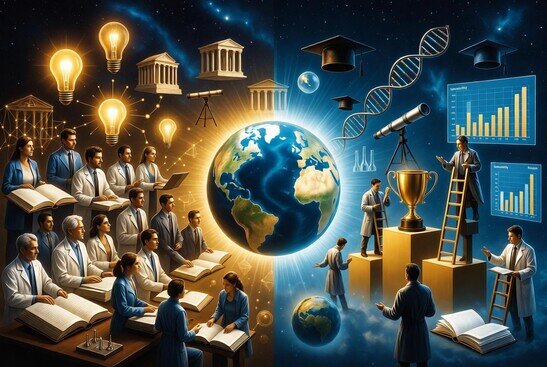
Is the idea of a common good feasible in the age of austere status competition in global science and higher education? While working on these two concepts in parallel, Simon Marginson prompts his readers to address this thought-stimulating question in the international arena where appeals for the former are few, and compliance with the latter is significant. How do we understand a common good in science, where national and global interests collide as well as cohere? Is the good achievable in the contexts where universities reinstate rather than resolve unequal opportunities in research and teaching? The previous literature suggests irreconcilable asymmetries in institutional resources, research capacities, and intentions for scientific and socio-economic impact. Can transnational solidarity, new technologies, and reformed institutional logics facilitate an alternative route and offer sensible solutions?
On 14 April, 2026, these questions grew bigger when fellows and students of the Centre for Higher Education Leadership and Policy Studies at the Education University of Hong Kong hosted the world-leading scholar in global higher education, Professor Simon Marginson. His recent book Global higher education in times of upheaval and his presentation ‘”What school did you go to?” Status competition as a determining factor in higher education’ became the source of discussion on the EdUHK campus. The reflexive commentary below provides an interesting conversation on the challenges of combining the apparent inevitability of competition with the common good approach.
Obstacles to the common good: The tension between inclusion and stratification in higher education and science
Simon Marginson, Professor of Higher Education at the University of Bristol and at the University of Oxford (emeritus), Visiting/Honorary Professor status at the University of Melbourne, Tsinghua University, the University of Hong Kong and Peking University
The moral argument for a common good approach to higher education and research is unquestionable and touches the hearts of many people in societies all over the world. Of course, learning, knowledge, personal growth and social improvement are desirable for all and higher education should benefit everyone, without fear or favour. Good education and science are like good health, clean water, an adequate food supply and freedom from violence and war, common goods that ought to be treated as universal human rights. Of course, university science ought to be focused in a cooperative way on solving common human problems, among which the climate-nature emergency and all its ramifications stand out. Of course, universities and other higher education institutions ought to provide learning opportunities to every member of national populations who want to access them, not just those who are academically, socially or financially selected. Of course, every higher education institution should work at a high level of provision rather than strong programmes being monopolised by the social and intellectual elite.
Global common good can be understood as an ethical relation of mutual growth, well-being and sustainability at world level, embracing human society and nature, in which the good of each part is fulfilled through the good of the whole, and vice versa. It can be realised at the world or regional levels, in particular nations, and also in particular higher education institutions. Every local step towards the common good is a step forward in the common interest. In my open access Bloomsbury book Global higher education in times of upheaval: on common good, geopolitics and decolonialisation (Marginson, 2026) I argue for a common good approach in and through higher education and research, discuss how this can be made practical, and review the obstacles. It must be acknowledged that while the potentials are there, and we in higher education already pursue the common good in some respects, the obstacles are formidable.
In both research and higher education, there are two main challenges. First, the challenge of plural thinking – to think not just in terms of national identity but to think also in terms of one-world, the world as a whole as a political subject in its own right. In this nation-state dominated era many see the world only as a space for the play of national interest and inter-national contestation, perhaps a space for domination and exploitation. But the reality is that the world is one inter-dependent entity. The ecological perspective applies also to human society. The conditions and actions of each nation and each university affect all of the others. Rather than seeing ourselves as national citizens whose international higher education activities are conducted at the margins of the ‘real agenda’, the national agenda, we need to understand ourselves in terms of dual identity. Members of nations and members of the world. Global science already operates on that double premise, though less than perfectly, as I now discuss.
The second challenge is to finally overcome the tension at the heart of the evolution of modern higher education and science. That is the tension between the tendency to expansion and inclusion – whereby more and more nations have developed capacity in science, and within nations, participation in tertiary education has spread to more and more of the population – with the tendency to vertical stratification. Stratification here refers to the creation of ranked hierarchies of value, including restrictions of what counts as relevant knowledge in research and who can produce high value science, and the reproduction of an elite layer of universities in many (though not all) countries that are dominated by the social elite, the affluent families.
In science the networked global system is a brilliant mechanism for advancing cooperation. More than sixty countries now have their own self-reproducing national science system joined to the global circuit, with doctoral training in at least some disciplines, and almost one quarter of all published papers have authors from more than one country. The geopolitical closure of certain borders (e.g. Russia/Ukraine) and the securitisation and over-regulation of some cooperative relations (e.g. U.S./China) have impaired global science but not fragmented it. The global conversation remains epistemically dominant over nationally bordered conversations in most disciplines based in the national sciences as well as being influential in other disciplines.
However, as Yusuf Oldac notes below, global science is vertical as well as horizontal in nature. There is a hierarchy of value in knowledge and this maps onto and is reproduced by global relations of power. We have the technology to establish a multi-lingual publishing regime in which every paper and book is translated into every main language – but the science publishing world continues to turn its back on that exciting possibility. In science English is still the only possible shared language, as reflected in the practices of the five leading academic publishers, all based on the Anglosphere and Western Europe, and the inclusion protocols of the two leading bibliometric data bases which define legitimate world science: Web of Science and Scopus. The hierarchy of value in science is controlled at the intersection of the leading universities, journal editorships, publishing and bibliometrics. It has two aspects: an inclusion/exclusion binary, and stratified value of what is included. Only 5 per cent of the world speaks English as an L1 but knowledge generated in every other language, including all indigenous knowledge in crucial fields like ecology and agriculture, is not just low value, it is completely excluded. Within the science system, Western and especially Anglophone universities still exercise the main authority; although in the STEM disciplines, China’s and Singapore’s leading institutions now generate more top 1% science than Harvard and MIT.
There is a parallel pattern in the education of students. The worldwide Gross Tertiary Enrolment Ratio (GTER) now exceeds 42 per cent and in more than 70 countries more than half of the age cohort now participates in tertiary education (UNESCO, 2026). Social inclusion has advanced tremendously. In that respect the common good role of higher education has transformed tremendously when compared to three decades ago when the world GTER was at 15 per cent. However, in many – though not all – countries there is a steep stratification of status and resources between the leading research universities and most other higher education institutions. In most though not all cases (the University of California is an interesting exception) these leading research universities are dominated by students from socially elite families, who are best placed to succeed in the fierce academic competition for entry. For the most part, the academic elite is the social elite and reinforces the reproduction of inequality in society.
The status hierarchy in the university sector has scarcely changed in the modern period. The ascendancy of the top private U.S. universities mostly dates from the nineteenth century, and Oxford and Cambridge, which are seen by all in the UK as positioned well above the rest of the Russell Group, and the gateway to privileged graduate careers and academic distinction, have ruled English higher education since the thirteenth century. The problem is not so much that these universities are strong but that the order of institutions in higher education is zero-sum, so that the strength of the leading universities means other institutions are both subordinated and weakened. Hence, the very institutions that we rely on most to generate global common goods in research are also the institutions that fragment the common good in society at home. The answer here is not to diminish the top universities but to level up the system by narrowing the gaps in resources and status between tier 1 and tiers 2/3 – to create not just ‘World-Class Universities’ but ‘World-Class Systems’ in which all institutions create significant social value.
Like the problem of the English language monopoly in science, the problem of elite capture of status in higher education has long been with us, but it is continually evolving and there is always potential for change. Indeed, the social role of higher education is now being shaken up.
Arguably, higher education in many country has three primary roles in social allocation: (1) the formation and legitimation of the social elite, (2) the reproduction and sorting of the middle class, and (3) the legitimation of a social and economic underclass, in which people are taught that their exclusion from the status and resources of the middle class is their own fault because they failed in education. The smaller is group (3), the closer that higher education comes to at least the outlines of a common good approach. The narrower the gap in perceived quality between (1) and (2), the closer that higher education comes to a common good approach. The high participation Nordic countries best exemplify the combination of near universal participation with relatively ‘flat’ systems in terms of stratification, in which all universities provide doctoral education with good national standing and globally recognised quality.
Now, in mostly slow-growing Western economies that are becoming more unequal (Chancel et al. 2026) in which the middle-class share of incomes and wealth is declining, the middle-class role (2) is faltering at the bottom end, with less career opportunities for graduates compared to their growing number. Further, elite reproduction at the top of the pyramid is becoming more decoupled from upward mobility routes, especially in the U.S. This suggests that the equation between elite institutions and the social elite is becoming more pronounced, roles (1) and (2) are peeling away from each other, and that fragmentation of the social role of higher education is felt primarily in mission (2). In addition, however, people assigned to the underclass (3), cut off from any prospect of securing social status in higher education, have discovered the politics of higher education and have an obvious motive to diminish its status-creating function.
In the U.S. group (3) has played a key role in the election of Trump governments in 2016 and 2024 and is likely to be cheering on the U.S. Administration’s assault on the top research universities. This in turn may trigger long overdue moves by the research universities towards increased social access and social service, recovering the Lands Grant mission. We can hope.
In East Asia, unlike the rest of the world, the middle-class share of income is growing vis a vis the share of the social elite (Chancel et al., 2026). Given that structuring and sorting of the middle class is so central to modern higher education, this underpins the relatively high level of social and political support enjoyed by the university sector in East Asia, including the pattern of annual increases to research funding in some systems. The latter enables East Asian universities to expand their contributions to the global common good through science and other fields of knowledge, though they could do more if work in Chinese, Japanese, Korean and Vietnamese was admitted as part of the global conversion in a multi-lingual publishing regime. On the other hand, there is a pronounced problem of high stratification in the Chinese civilisational zone, with long roots in the traditional elite forming role of Imperial higher education. The challenge before East Asian higher education is to lift the second and third tier institutions so as to expand the common good capability of the now very high participation higher education systems.
Redefining Excellence: Global Science, Status Competition, and the Common Good
Yuzhuo Cai, Professor, Department of Education Policy and Leadership & Co-Director, Global Research Institute for Finnish, European and Global South Education, The Education University of Hong Kong
The key issue in Simon Marginson’s chapter is not simply that universities should serve the common good. The deeper question is whether the contemporary organisation of global science is itself intensifying a status order that restricts the institutional space for the common good. If so, the common good cannot be treated as a moral supplement to the world-class university model. It must instead become a critical lens for rethinking how excellence is defined, how knowledge is legitimised, and what purposes universities are expected to serve (Marginson, 2026).
This, in my reading, is one of the most important contributions of Marginson’s chapter. He does not portray global science simply as an open and collaborative knowledge community. Rather, he shows its dual character. On the one hand, global science has enabled unprecedented levels of cross-border collaboration, rapid circulation of knowledge, and wider participation in global knowledge production. On the other hand, it is structured by English-language dominance, Western epistemic norms, international publishing platforms, bibliometric systems, and the ranking logics built around them. For that reason, global science is not only a site of knowledge sharing but also a mechanism of selection, valuation, and stratification. The same system that appears to universalise knowledge also differentiates, with increasing precision, who is authorised to represent that universal knowledge and who remains peripheral to it (Marginson, 2026).
This is precisely where the discussion of world-class universities needs to become more critical. For a long time, world-classness has been defined mainly through citation impact, research output, resource concentration, international reputation, and ranking position. These indicators may capture competitive performance, but they say much less about whether universities contribute to broader shared goods such as social justice, ecological sustainability, epistemic inclusion, or meaningful responses to global challenges. In this sense, the prevailing world-class university model is not neutral but deeply embedded in the power structure of global science and reproduces inequality through standards that appear objective but are historically and geopolitically situated. The difficulty facing the common good, therefore, is not only how to realise it, but how to secure institutional legitimacy for it within a system whose normal mode of operation is the production of differentiated status.
It is here that my co-authored work seeks to push the discussion further. I argue that the combination of the Sustainable Entrepreneurial University (Cai & Ahmad, 2023) and Internationalisation of Higher Education 3.0 (Cai & Leask, 2026) should not be understood as a minor adjustment to the existing world-class university model, but as an attempt to rework its internal logic. The Sustainable Entrepreneurial University suggests that innovation can no longer be reduced to economic growth or market transfer alone; it must be redirected towards social and ecological transformation (Cai & Ahmad, 2023). Internationalisation of Higher Education 3.0 likewise implies that internationalisation should no longer be organised mainly around reputation accumulation, student recruitment, and positional competition. Instead, from an outside-in perspective, it should be oriented towards societal challenges, co-produced knowledge, and wider public benefit (Cai & Leask, 2026). Without such changes in both organisational purpose and internationalisation logic, the common good will remain rhetorical.
The real question, then, is not whether universities can pursue the common good while retaining excellence but whether prevailing definitions of excellence have themselves been overly shaped by hegemony, metric rationality, and status competition in global science. The common good becomes meaningful only when it enters the debate over what counts as excellence in the first place.
Beyond Status Competition: Toward a Humanistic Ontology of Higher Education as Global Common Good
Soyoung Lee, Assistant Professor, Department of Education Policy and Leadership, the Education University of Hong Kong
The reconceptualisation of higher education as a global common good offers a powerful counterpoint to the dominant neoliberal framing of universities. Within this framework, Marginson helps us redefine knowledge as a shared intellectual resource, and humans as collective contributors rather than competitors within an epistemic community. The rapid development of COVID-19 vaccines through cross-border scientific cooperation, and the coordinated pursuit of the Sustainable Development Goals, illustrate this relational logic in action.
Yet the prevailing logic of higher education worldwide continues to be structured by status competition, grounded in an understanding of education as a primarily individualistic and pecuniary good (Marginson, 2024). This narrowing obscures the more intrinsic and broader contributions of higher education, such as intellectual exploration, personal transformation, and the wider social goods that universities generate (Lee, In Press). Crucially, when non-pecuniary and collective goods become invisible, the only goods left to pursue are positional ones, which are intrinsically zero-sum (Brown, 2003). The resulting contest over a homogeneous prize becomes a crowded struggle for the representation, recognition, and redistribution of economic and symbolic status. This reinforces academic capitalism (Slaughter & Rhoades, 2004), in which knowledge is commodified and scholars and students are treated as units of human capital. This is the very ontological reduction that Nussbaum (2011) critiques as a profound failure to ask what each human being is actually able to do and to be.
Marginson points out that the more troubling point is that status competition does not reconstruct but reproduces the existing order. Why? Scholars have widely discussed the familiar culprits: the expansion of private education, the global ranking industry, and the hegemony of English language (Shahjahan & Edwards, 2022). While these mechanisms undoubtedly matter, I argue that they are expressions of a deeper ontology rather than independent causes. Rankings presuppose that universities are commensurable competitors; privatisation presupposes that education is an individual investment; English hegemony presupposes a single, centralised epistemic marketplace. All three rest on a reductive construction of students, scholars, and other stakeholders solely as homo economicus rather than as agents capable of collective action and moral deliberation.
The consequences are unevenly distributed. Global ranking systems advantage already-prestigious institutions while depleting emerging ones with weaker reputations. Gendered divisions of academic labour persist, as women disproportionately carry teaching and care work while men accumulate the research outputs that rankings reward. Disciplinary hierarchies privilege STEM fields and positivist epistemologies, marginalising the humanities and non-Western knowledge traditions. When combined with the premium placed on mobility toward the centre of the global knowledge system, these hierarchies widen inequality because mobility itself is a privilege. In East Asia, these dynamics are amplified by a culture of education fever that fuses academic success, social respect, and intellectual prestige into a single package. Reconstructing higher education as a common good, beyond the field of status competition, therefore requires more than rhetorical reframing. It demands a humanistic ontology that restores moral agency to students, scholars, and institutions. Agency is not merely the autonomy to succeed within the existing game; it is the capacity to move beyond positional logic and to enable knowledge production as a relational, collective endeavour. As agents of knowledge, we need not wait for further climate catastrophes, pandemics, or widening inequality to compel us to see one another as co-contributors to a commons we cannot build alone.
Cross-border scientific relations as a means to foster global common good
Yusuf Oldac, Assistant Professor, Department of Education Policy and Leadership, and Fellow, Centre for Higher Education Leadership and Policy Studies, The Education University of Hong Kong
Contemporary debates on global science and higher education are increasingly shaped by an understanding of research as a competitive arena among nation-states. This framing resonates with the reading-group discussion of the chapter ‘Configurations of Power in Global Science’ in Global Higher Education in Times of Upheaval, which highlights that the epistemic openness of global scientific networks continues to be materially and legally nested in national science systems and state priorities (Marginson, 2026). In periods of geopolitical strain, this duality becomes more visible as national imaginaries and security logics seek to reassert control over cross-border scientific relations. Within this perspective, science is frequently framed as an extension of geopolitical rivalry, in which states pursue strategic advantage through knowledge production and technological supremacy. As Marginson (2022) demonstrates in his discussion of competing narratives of global science, such an “arms race” understanding privileges national interests over collective advancement and tends to obscure alternative imaginaries of international scientific cooperation. When this narrative gains prominence, governments become more inclined to restrict knowledge sharing, scrutinise cross-border collaborations, and impose tighter controls on research funding and co-investigator arrangements.
The implications of this competitive framing are visible in recent policy developments across several national systems. We witness governments opposing the approval of certain international co-investigators, limiting shared funding arrangements, and applying heightened surveillance to research activities. These dynamics are especially salient in contexts marked by geopolitical tension, such as the intensifying scientific competition between the United States and China. As recent research shows, such competition increasingly shapes science policy debates within these systems and has important spillover effects on other systems navigating a rapidly multipolar global science landscape (Oldac, 2024). In such environments, global science risks being reduced to a zero-sum competition, where collaboration is viewed as a vulnerability rather than a source of collective strength.
While the arms-race narrative currently attracts substantial policy attention, what appears to be insufficiently recognised in higher education debates, especially in policy circles, is the alternative possibility of positioning global science as an open and expanding international network of scholars. From this perspective, learning from one another across borders is not exceptional but constitutive of scientific progress. International collaboration enables the pooling of expertise, the cross-fertilisation of ideas, and the collective addressing of complex challenges that transcend national boundaries. Moreover, such collaboration holds an important trust-building function. When academic communities visibly engage in cooperative and dialogic practices, they contribute to broader societal imaginaries oriented towards mutual understanding rather than antagonism, thereby supporting the conditions for a more stable and secure global order.
My recent research has sought to advance this latter understanding of global science by empirically and conceptually examining the benefits of sustained international collaboration. Our investigation of 25 years of historical bibliometric evidence from Northeast Asia demonstrates that cross-border knowledge production over time can generate benefits for all participating systems, even amid challenging geopolitical conditions (Wang & Oldac, 2026). At the same time, research also indicates that research-intensive systems such as the United Kingdom risk undermining their own scientific capacity when policy shifts towards curbing the openness of academic exchange (Oldac & Olivos, 2025). Further evidence from Southeast Asia suggests that sustained collaboration across borders can contribute to the development of more inclusive and harmonious regional research spaces, particularly when global science is approached as a shared enterprise rather than a competitive hierarchy (Oldac et al., 2025).
Taken together, these observations underscore that global science possesses the capacity to shape different futures. When treated primarily as a competitive space, it is likely to exacerbate stratification and reinforce existing inequalities within the global knowledge system. However, when mobilised as a vehicle for contributing to the global common good, global science offers considerable potential benefits for higher education and for humanity more broadly. Ultimately, these competing trajectories are not structurally predetermined. They depend on the choices made by governments, institutions, and individual academics. Recognising our own agency as actors within higher education is therefore essential, as it is through such agentic decisions that more collaborative and common-good-oriented forms of global science can be realised.
Higher Education and Social Status in the AI Era
Ewan Wright, Associate Professor and Associate Head, Department of Education Policy and Leadership, the Education University of Hong Kong
Worldwide, higher education is expected to serve the common good by providing equality of opportunity for all students to attain social status, regardless of their family background or identity. Through hard work and talent, students can accumulate higher skills and credentials that offer an advantage for entry into professional and managerial roles – i.e., the graduate premium. As Baker (2014) argued in his book ‘The School Society’, modern societies have ‘delegitimated’ almost all non-educational forms of status attainment, such as inherited social position. The idea behind this is a meritocratic logic whereby not only do all students have opportunities to flourish in education, but also people are funnelled into careers that match their aptitude, interests, and talents, with the most able entering positions of high-status power.
Critical scholars, notably Bourdieu (e.g., 1984) and his followers, have long highlighted the limitations of such arguments. Instead, deep social inequalities mean that meritocracy is an illusion that masks how higher education advantages the most privileged students by helping to reproduce their social status. In massified higher education systems worldwide, this inequality increasingly takes the form of stratification within higher education, rather than between graduates and non-graduates. It is well-established that students from privileged backgrounds are overrepresented in elite universities that continue to provide pathways to high social status and enhanced career opportunities (e.g., Chetty et al., 2025; Marginson, 2026).
However, advances in AI may be poised to disrupt the relationship between higher education and status attainment. Autor (2024) argues that while previous waves of technological automation hit routine jobs typically held by non-graduates, AI could displace high-status knowledge work associated with university graduates, whilst simultaneously enabling workers with less formal education to perform at a higher level. This is because AI excels at pattern recognition and decision support (e.g., analysing X-rays or drafting legal documents), which are core tasks within many high-skill professions. Consequently, AI may make complex skills available to everyone, thereby lowering the barrier to entering professional and managerial roles once the domain of graduates. If this prediction turns out to be true, the implications for higher education and status attainment are profound.
To conclude this piece, I present three possible futures for higher education in the AI era. A first possibility is a devaluation of degrees in labour markets. The graduate premium steadily erodes, as vocational education leading to practical skills becomes more valuable for careers, whereas the knowledge worker skills taught at universities become redundant. Universities may be reduced to institutions for a small and very affluent population, serving as a means for a ‘leisure class’ (Veblen, 1899) to socialise and display social status without direct economic value. A second possible future is that higher education continues to expand to near-universal levels as a degree becomes an essential entry qualification for virtually all occupations. Here, a bachelor's degree becomes the new high school diploma, with the curriculum increasingly focused on AI skills to build employability. While this would widen access to higher education to more people, an implication would be intensified competition among graduates for careers, whereby a degree provides a progressively less secure means to social status.
A third, more utopian, possible future is that AI leads to an era of abundance, whereby material needs are fully met by leaps in productivity. There would be little need or pressure to develop employability through higher education, as people would be set free from the economic imperative of waged employment. Everyone would have the resources and time to attend university, although not with the goal of career preparation. Instead, universities could serve the common good more broadly as institutions that serve the public through cultivating critical thought and sustaining the intellectual life of society. While each scenario is highly uncertain, it seems likely that as AI technology matures, existing links between higher education and social status will be fundamentally changed. Overall, all this requires critical reflection on the possible role of universities in serving the common good.
A Strange Question: Can We Compete for A Common Good Status?
Anatoly Oleksiyenko, Professor of International Higher Education, Department of Social Sciences and Policy Studies, and Executive Co-Director, Centre for Higher Education Leadership and Policy Studies, the Education University of Hong Kong
Higher education has been increasingly driving egotistic motifs in societies preoccupied with an apocalypse troika of global higher education: prestige economy, obsession with return on investments, and ceaseless pursuit of competitive advantage. While still claiming to generate a greater collective good, including higher participation and democratisation of learning, universities often beget unintended consequences, especially when prestigious degrees, higher GPAs and other distinction indicators are prioritised and praised in society and industry. The status competition generates hierarchies of achievers, as well as discriminative labour markets where ambitious and talented professionals reinforce aggressive performance to advance their privileges and prove their risk-taking abilities. Their pursuit of stronger competence and higher status will only increase with the rise of AI and other intelligent machines, which will continue to bring down the rest of the workforce.
Status differences are unlikely to disappear. The disparities have roots in the socio-economic backgrounds of families, as well as origins and capacities of communities, industries, and societies at large (Oleksiyenko, 2013). To level them down or enforce talent segregation will never be short of resentment and failure, as the Soviet experimentations showed in the previous century (Matthews, 2012). Imagine having siblings forcefully separated and trained in special institutions according to the school metrics measuring their cognitive and physical abilities in accordance with some central education authority’s plans and regulations. Early talent recognition and development can be argued to be good for the future of society. This would help the national economic systems achieve more and faster, especially when global competition becomes fiercer. In the neoliberal age, these Soviet-type arguments can appear as being quite sensible. Alas, as we well know, unhappiness rather than flourishing follows the denial of individual agency and freedom in choosing careers and making self-regulated adjustments in talent development (Ambrose, 2005). Moreover, making everyone see a common good from the same angle and through the same lens is largely impossible in a democratic society.
Can universities change perceptions of and attitudes toward competition instead? For example, nurture a culture of competing for a common good status? What if universities started to massively cultivate among their teachers, students, and alumni a sense of pride about being highly distinguished in sharing their privileges with the least advantaged in their societies? Imagine being proud of paying higher fees and rates on the same campus for the same courses and services just on the basis of coming from a higher-income household. What if teachers were awarded prizes and titles by ability to help peers with the most difficult kids and lowest performance to achieve the highest results possible in their cities and systems? What if the global rankers promoted status differentiation by the metrics of university scholarships to low-income talents, or donorship and fee-free support of courses on democracy, entrepreneurship, charity, and well-being bundled together? What if universities massively published and promoted stories of successful returns on investment in charitable cases?
Meanwhile, would scientists benefit more from teaching (as well as being taught) how to contribute to open science and develop meaningful education and research partnerships with low-income countries rather than with wealthy and prestigious counterparts? Could universities become institutions where outstanding positions of their faculties and departments be judged by how much of status improvement they make in the least advantaged households within their countries or in the least developed economies? What if the whole prestige economy got built around the rankings of common good pursuits?
Skepticism will certainly continue to prevail in the intellectual and political circles, where skepticism is a value per se. However, with security risks and human vulnerability increasing globally, being critically-minded for non-trivial concepts and solutions can be important. Discussing alternative strategies of education and science becomes essential, as Marginson (2026) argues in his newest book. The common good perspective is a worthy direction to pursue, and probably should be done competitively, in hopes to defy status anxieties created by the prestige economy of the neoliberal era. Comparing post-Soviet anxieties in higher education systems of China and Russia, my colleagues, Qiang Zha, Igor Chirikov, Jun Li, and I (2018/2024) had unveiled the growing complexity of geopolitical dilemmas facing status-conscious governments, universities and stakeholders in times of global rivalry. These would become even more dangerous, we argued, when soft and hard powers get mixed and misapplied in the process of status competition. Eight years later, we see that the deteriorating global security and worsening human conditions further corroborate the conclusion that competitive ambitions by all means and at all costs, whether at macro or micro levels, lead to disastrous outcomes.
References
Ambrose, D. (2005). Aspiration growth, talent development, and self‐fulfillment in a context of democratic erosion. Roeper Review, 28(1), 11-19. https://doi.org/10.1080/02783190509554332
Brown, P. (2003). The opportunity trap: Education and employment in a global economy. European Educational Research Journal, 2(1), 141–179. https://doi.org/10.2304/eerj.2003.2.1.4
Cai, Y., & Ahmad, I. (2023). From an entrepreneurial university to a sustainable entrepreneurial university: Conceptualisation and evidence in the contexts of European university reforms. Higher Education Policy, 36(1), 20–52. https://doi.org/10.1057/s41307-021-00243-z
Cai, Y., & Leask, B. (2026). Rethinking internationalisation of higher education for society from an outside-in perspective. Journal of Asian Public Policy, 19(2), 509–527. https://doi.org/10.1080/17516234.2024.2406093
Chancel, L., Gomez-Carrera, R., Moshrif, R. and Piketty, T. (2025). World inequality report 2026. https://wir2026.wid.world/www-site/uploads/2025/12/World_Inequality_Report_2026.pdf
Lee, S. (in press). Empowering Student Minds: Academic Self-Formation in Higher Education. [In press with Oxford University Press].
Marginson, S. (2026). Global higher education in times of upheaval: On common goods, geopolitics and decolonization. London: Bloomsbury Academic.
Marginson, S. (2024). Problems of the public good in higher education: Building the common amid sovereign individualism, capital and the state. Higher Education, 89(1), 29–52. https://doi.org/10.1007/s10734-024-01341-8
Marginson, S. (2022). What drives global science? The four competing narratives. Studies in Higher Education, 47(8), 1566–1584. https://doi.org/10.1080/03075079.2021.1942822
Matthews, M. (2012). Education in the Soviet Union: Policies and institutions since Stalin. Routledge.
Nussbaum, M. C. (2011). Creating capabilities: The human development approach. Harvard University Press.
Oldac, Y. I. (2024). Tectonic shifts in global science: US-China scientific competition and the Muslim-majority science systems in multipolar science. Higher Education, 87(3), 637–659. https://doi.org/10.1007/s10734-023-01028-6
Oldac, Y., & Olivos, F. (2025). Global research collaborations of the United Kingdom in the post-Brexit era. Higher Education. https://doi.org/10.1007/s10734-025-01596-9
Oldac, Y. I., Lim, M., Mok, K. H., Tran, L., Yang, L., & Nkansah, J. O. (2025). Southeast Asia’s cross-regional research collaborations in the multiplex world: Current trends and future paths. International Journal of Educational Research, 133, 102726. https://doi.org/10.1016/j.ijer.2025.102726
Oleksiyenko, A. (2013). Opportunity structures and higher learning in a globally-connected place: tensions and ties between outbound and upward mobility. Higher Education, 66(3), 341-356. https://doi.org/10.1007/s10734-013-9608-x
Oleksiyenko, A. V., Zha, Q., Chirikov, I., & Li, J. (Eds.). (2018/ 2024). International status anxiety and higher education: The Soviet legacy in China and Russia. Springer Nature.
Shahjahan, R. A., & Edwards, K. T. (2022). Whiteness as futurity and globalisation of higher education. Higher Education, 83(4), 747–764. https://doi.org/10.1007/s10734-021-00702-x
Slaughter, S., & Rhoades, G. (2004). Academic capitalism and the new economy: Markets, state, and higher education. Johns Hopkins University Press.
UNESCO (United Nations Educational, Social and Cultural Organisation) (2026). Institute of Statistics. Data. http://data.uis.unesco.org
Wang, L., & Oldac, Y. (2026). Stronger together: 25 years of knowledge production in Northeast Asia. Higher Education. https://doi.org/10.1007/s10734-026-01633-1
To cite this paper: Marginson, S., Cai, Y., Lee, S., Oldac, Y., Wright, E. and Oleksiyenko, A. (2026). Common Good and Status Competition in Global Science and Higher Education. Universities & Intellectuals. https://chelps.eduhk.hk/page/detail/1129